 Emiton







































Statmux · statistical multiplexing
Use the whole band more efficiently — pack spread-out channels into a compact block.
High-bitrate VBR channels, packed into a handful of muxes in real time — so you occupy a small, clean slice of spectrum instead of fighting the entire band. The peaks of one channel fill the valleys of another, and the freed spectrum buys robustness instead of brute-force packing.
The problem
An overcrowded band punishes the whole plant.
Modern channels are high-bitrate VBR. In fixed CBR muxes you fit maybe three per mux before overflow — so you spread dozens of muxes across the entire band, push QAM-256 everywhere, and now the whole plant has to be perfect: amplifier linearity, tilt, return loss, cable condition across hundreds of MHz. One weak spot anywhere and subscribers get artifacts — and you get truck rolls.
How it works
You set the pool. Emiton allocates the bits.
Set the pool
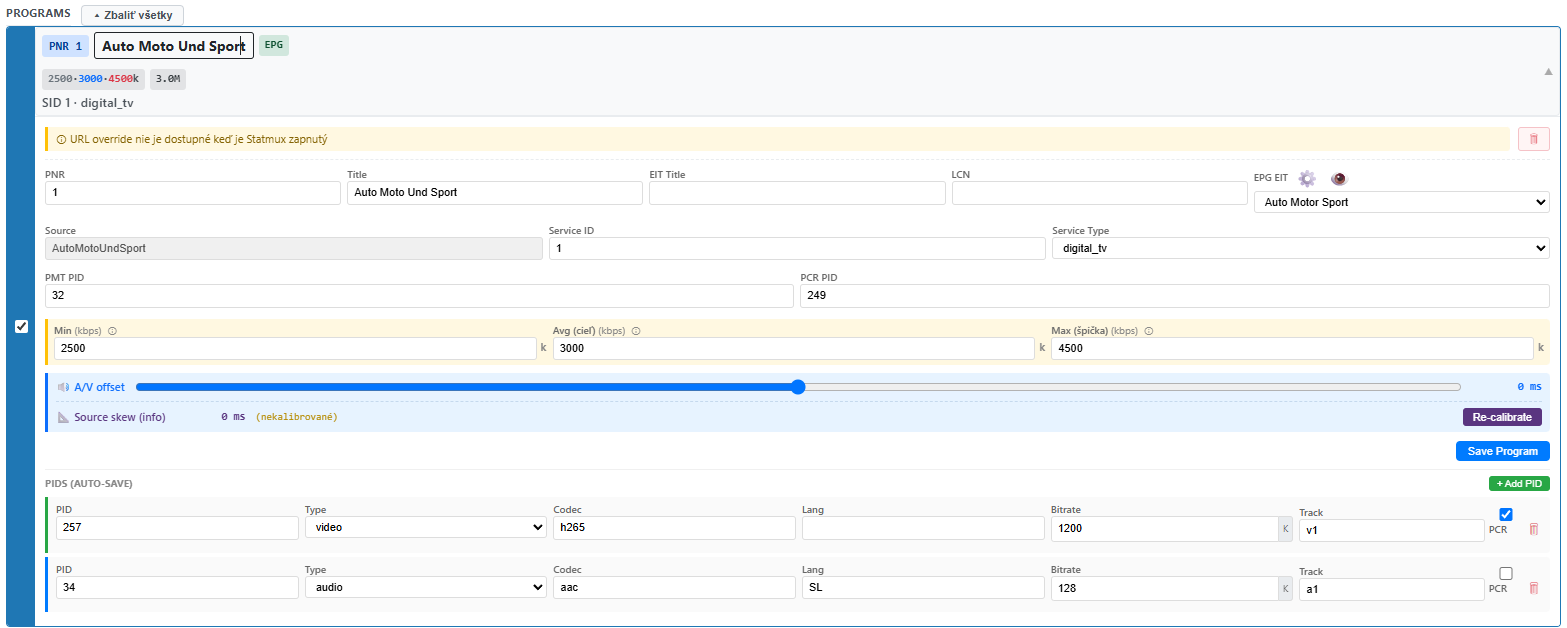
How many channels, the total MPTS bitrate, and per-channel minimum, maximum and priority. That's the whole configuration.
Real-time, by scene
Bitrate follows scene complexity — busy motion gets more, static scenes hand bits back. The peaks of one channel fill the valleys of another.
Fixed budget, minimal waste
The aggregate always stays inside your transport budget, with minimal null padding — every bit that isn't picture is spent on picture.
The same class of dynamic, scene-aware rate control as AWS Elemental Statmux — delivered as software, on your own GPU hardware.
Measured on a running system
Real numbers, not a datasheet.
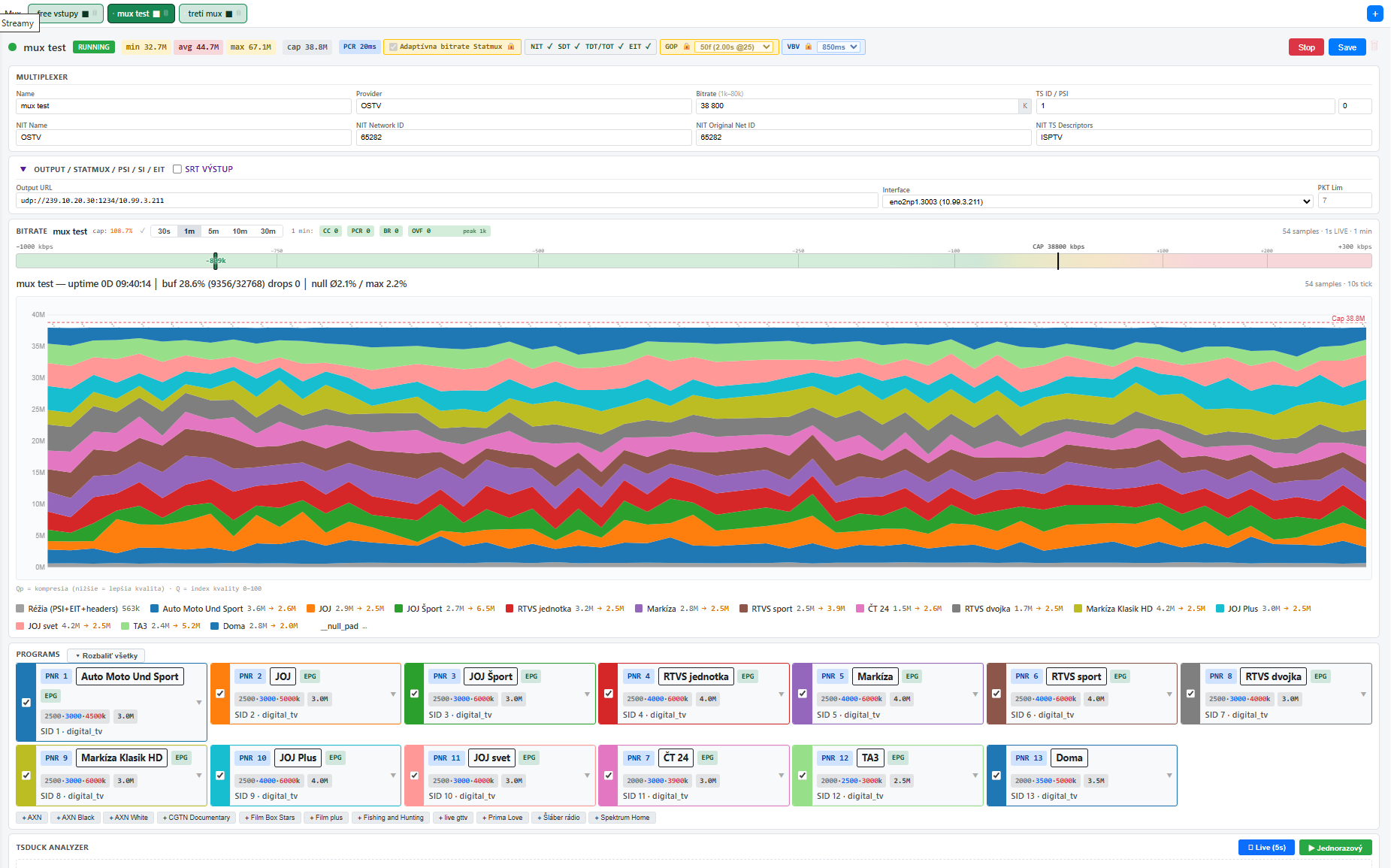
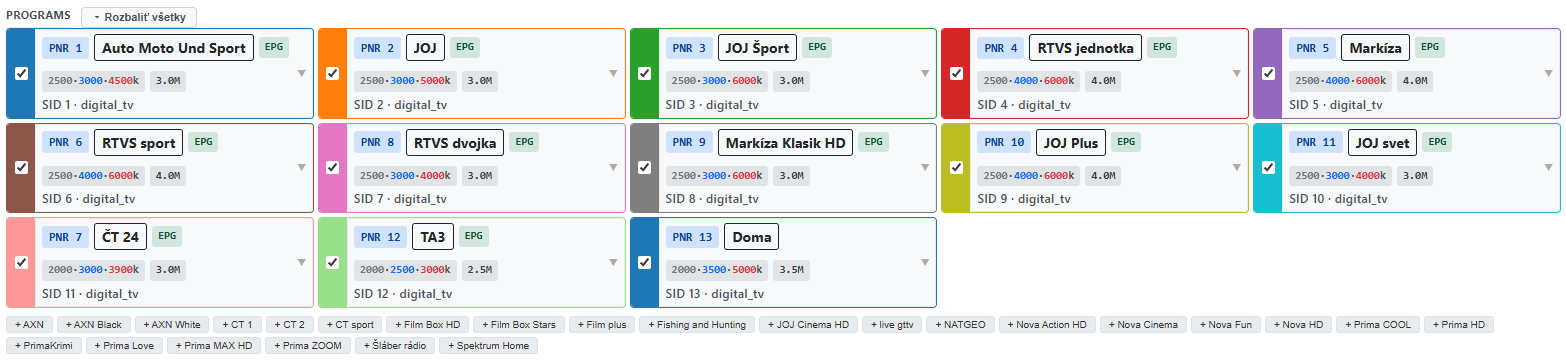
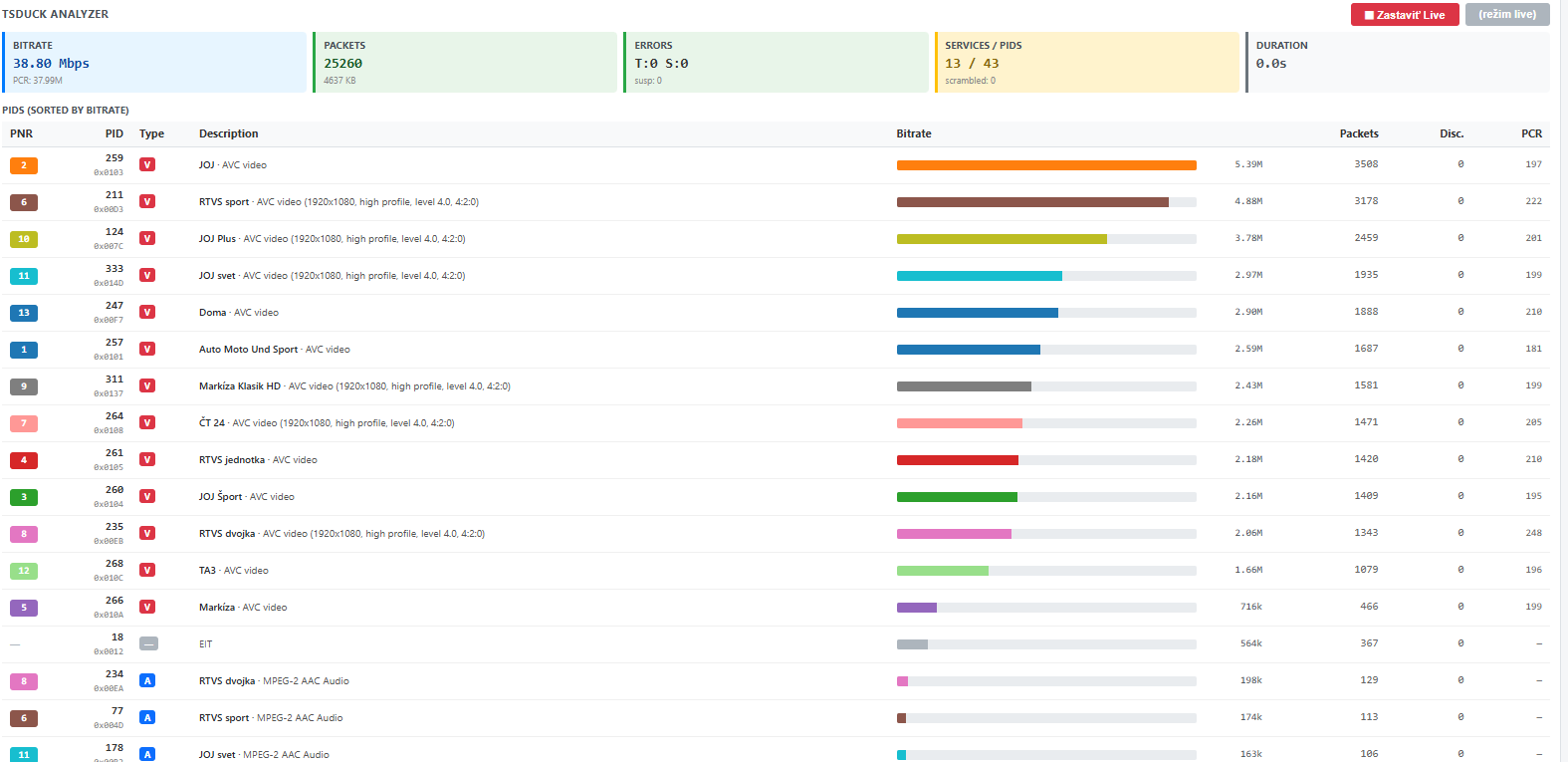
13 services in one MPTS plus a playout channel — 14 encoder sessions on a single RTX 5060 Ti, sampled over 3 minutes.
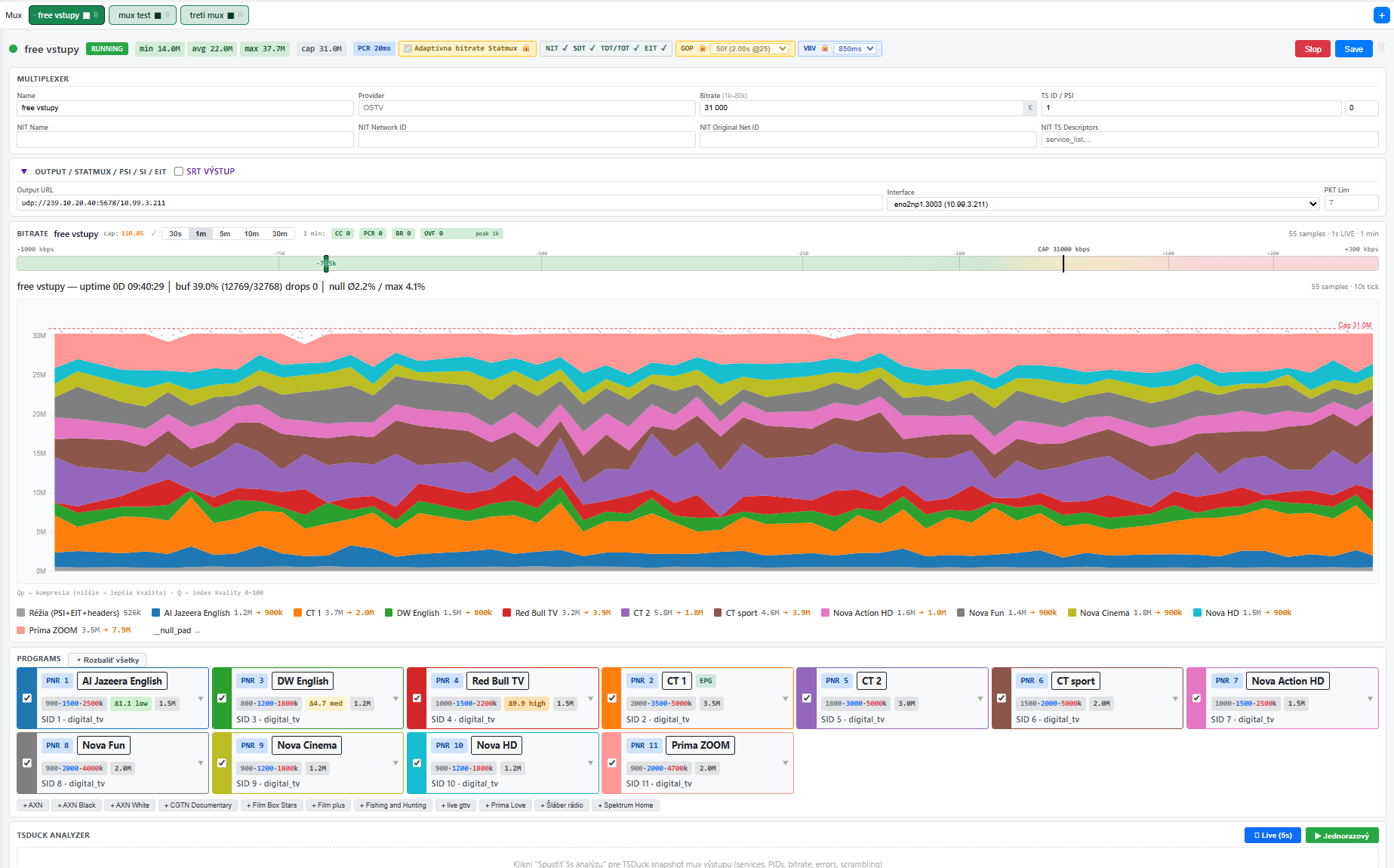
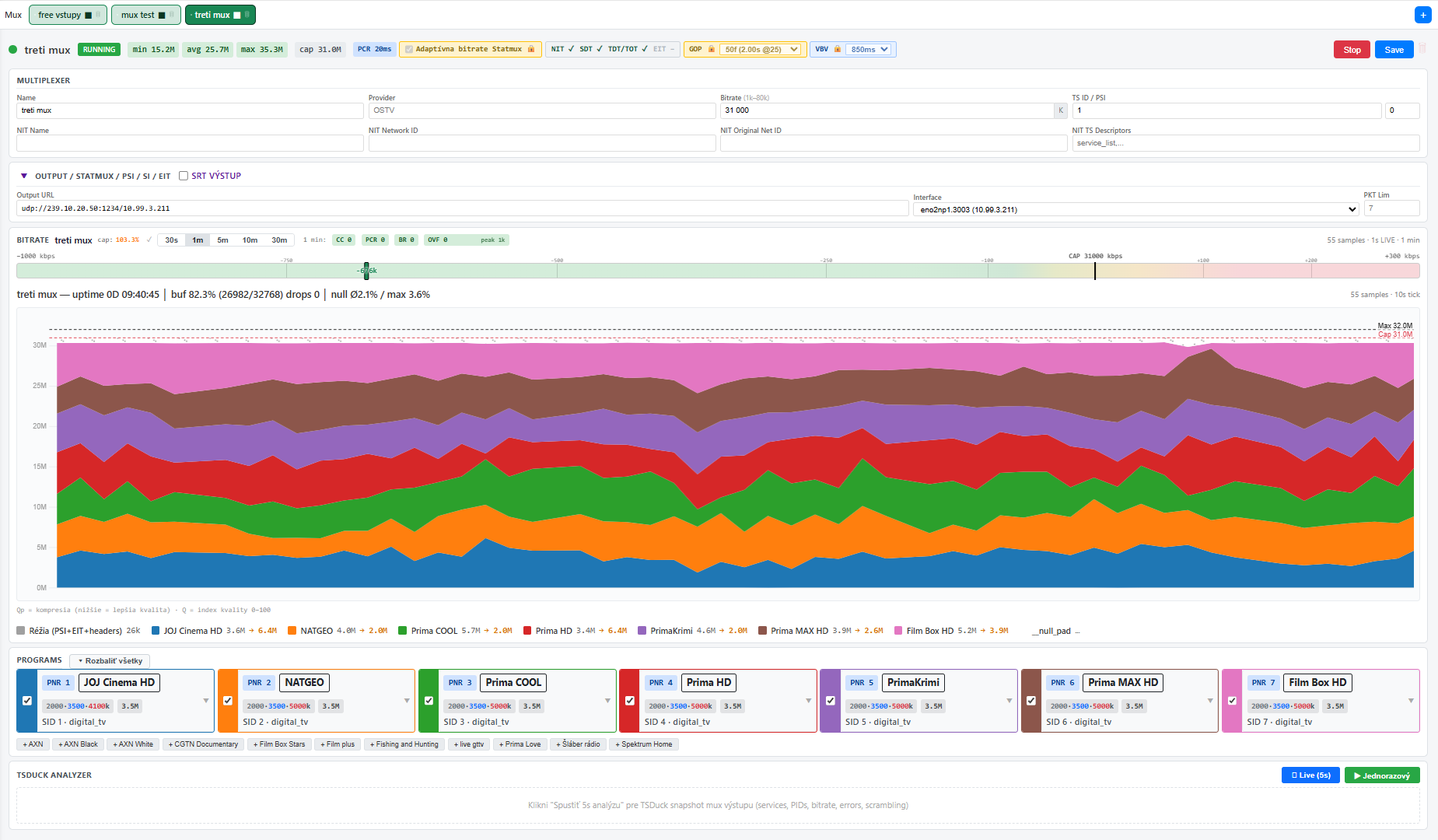
Live statistical multiplexer — real per-channel bitrate allocation on a 38.8 Mbit MPTS, straight from the running system.
Per-channel bitrate swings up to 1.86× and spreads 1.94× across the pool — one service moved 2.13 → 4.13 Mbps as scenes demanded. A consumer card doing work that would otherwise call for a Tesla A16 or RTX 6000 Pro.
Statmux vs CBR — measured with VMAF
Same content, same encoder, an identical total budget of 6 214 kbps. The only difference is how the bits are split: CBR gives every channel an equal share; statmux allocates by scene complexity.
| Channel | VMAF · CBR | VMAF · statmux | Δ |
|---|---|---|---|
| Jednotka 2071 → 1320 kbps | 82.27 | 79.88 | −2.39 |
| RTVS Šport 2071 → 2260 kbps | 66.97 | 67.56 | +0.59 |
| Dvojka 2071 → 2633 kbps | 61.89 | 65.87 | +3.98 |
| Worst channel | 61.89 | 65.87 | +3.98 |
| Spread across channels | 20.38 | 14.01 | 31% tighter |
| Mean | 70.38 | 71.10 | +0.73 |
The easy channel gave bits away and lost 2.4 points — while staying at 79.9, where no viewer notices. The hardest channel gained 4. Subscribers don't judge you on the average; they judge you on the worst channel in the line-up — and that's the one that improved most.
Reference: a 12 s lossless excerpt, three 1080p services. Complexity was measured independently at CRF 23 rather than taken from the live statmux's own allocation, to avoid a circular result. Model vmaf_v0.6.1, x264 preset medium, identical settings for both variants. The full production run is below.
The full run — 13 services, measured VMAF
The complete 13-service MPTS — the same 37.9 Mbps run — with every channel scored by VMAF over 2 400 frames. This is the statmux output itself, not a lab excerpt: mean VMAF 91.1, eight of thirteen services above 90, on a single RTX 5070 Ti.
| Channel | VMAF · mean | Worst 5% | kbps |
|---|---|---|---|
| JOJ Plus | 96.99 | 91.69 | 3034 |
| TA3 | 95.32 | 93.64 | 2458 |
| Auto Moto und Sport | 93.59 | 83.17 | 3119 |
| Jednotka | 92.79 | 85.77 | 3333 |
| Doma | 92.10 | 82.84 | 2800 |
| ČT24 | 90.45 | 81.03 | 2589 |
| Dvojka | 90.40 | 68.82 | 3281 |
| JOJ | 90.20 | 72.84 | 2736 |
| Markíza Klasik | 89.75 | 79.37 | 2692 |
| RTVS Šport | 89.40 | 77.72 | 2906 |
| Markíza | 88.30 | 66.72 | 3023 |
| JOJ Svet | 87.99 | 55.58 | 3218 |
| JOJ Šport | 87.65 | 76.83 | 2695 |
| Mean · 13 services | 91.1 | — | 37.9 Mbps |
Measured on tsc01, 2026-08-03: 13 services in one MPTS, 2 400 frames per channel, VMAF model vmaf_v0.6.1. "Worst 5%" is the 5th-percentile frame — the hardest 5% of motion, where any encoder dips; the mean is what a viewer sees across the programme.
The fuller run — 28 channels on the production encoder
The whole line-up under full load — 28 channels, measured live and self-updating straight from the running system.
See the live 28-channel VMAF →When spectrum is scarce
A small allocation, a full line-up.
An MMDS licence gives twelve carriers at best — in practice often five or six, shared with other operators. Terrestrial DVB-T2 usually means two or three multiplexes. That is the whole space you have to work with.
At five carriers — and even more so at three multiplexes — statistical multiplexing stops being an optimisation. It becomes the only way to fit a line-up worth paying for into the spectrum you have been allocated.
Screenshots